Embraer
Embraer E-Jet E2 (E190-E2/E195-E2)
Your answers
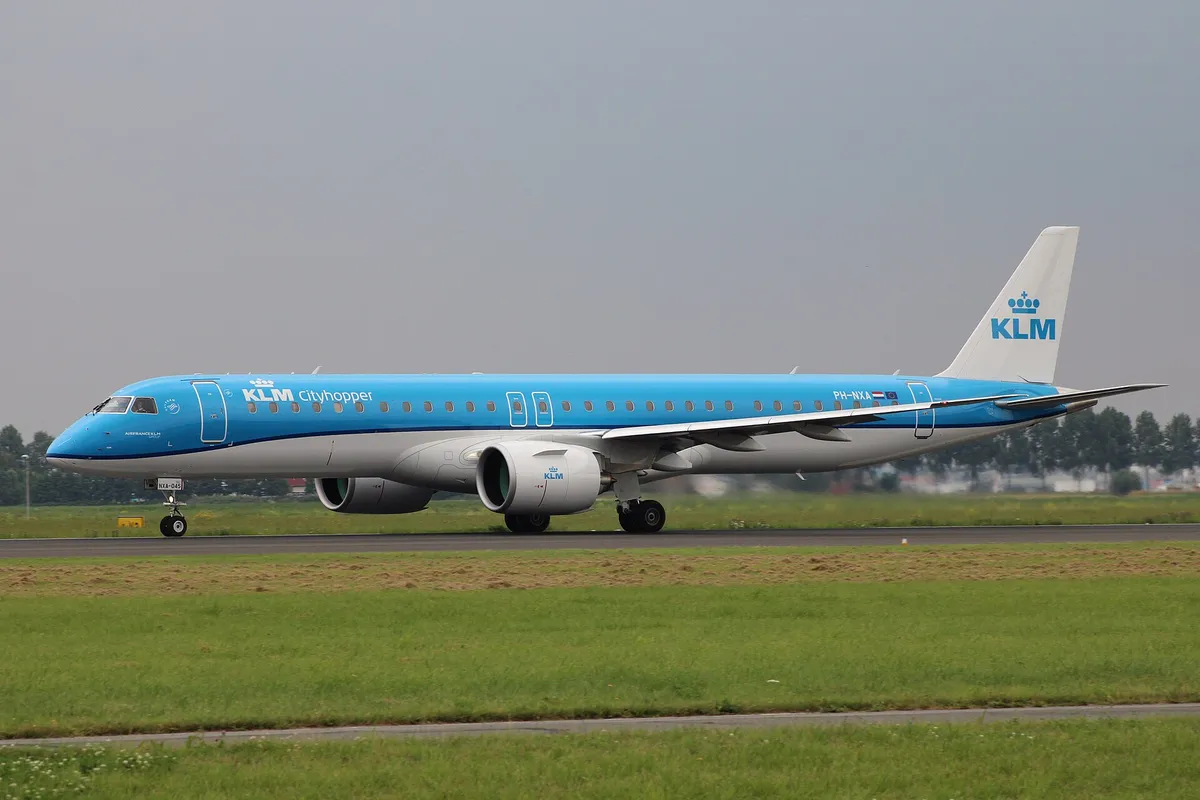
From below
The view you'll actually get from high overhead.

Field marks
- Underwing engines and a low tail separate any E-Jet from a CRJ or ERJ, which have engines on the back of the body under a T-shaped tail
- The geared-turbofan PW1900G has a 2.01 m fan, 66 cm bigger than the E1's CF34 — the engine pods look closer to narrow-body-jet engines than to a typical regional jet's, distinctly bulkier than any E170/175/190/195
- A swept, pointed wingtip replaces the E1's upturned blade — no separate blade bends upward, the tip itself just tapers back sharply
- If you see one at a US airport in regional-jet colors, it is almost certainly an E190-E2 or E195-E2, not the still-unbuilt E175-E2
- Slightly softer, less pronounced "eyebrow" around the cockpit windows than the E1 generation, on a more tapered nose profile
Specs
- Length
- 41.60 m
- Wingspan
- 35.10 m
- Engines
- Pratt & Whitney PW1900G
- Typical seats
- 96–146
Size and shape, to scale
Photos can't hold a consistent scale from shot to shot — these silhouettes are all drawn at the same 10 px = 1 m scale, so the proportions here are trustworthy even though the photos above aren't.
Variant notes
- The E195-E2 (41.6 m, up to 146 seats) is the dominant, best-selling variant, with 300+ orders and 200+ delivered to carriers including Azul, KLM Cityhopper, and Air Astana
- The E190-E2 (36.24 m, up to 114 seats) shares the same wing and engines on a shorter body and sells in smaller numbers
- The E175-E2 does not yet fly commercially — Embraer has repeatedly paused the program (most recently pushed to 2029) because its higher weight breaks US regional-airline scope-clause limits; every E175-E2 order on the books is still unfulfilled