Embraer
Embraer ERJ145
Your answers

From below
The view you'll actually get from high overhead.
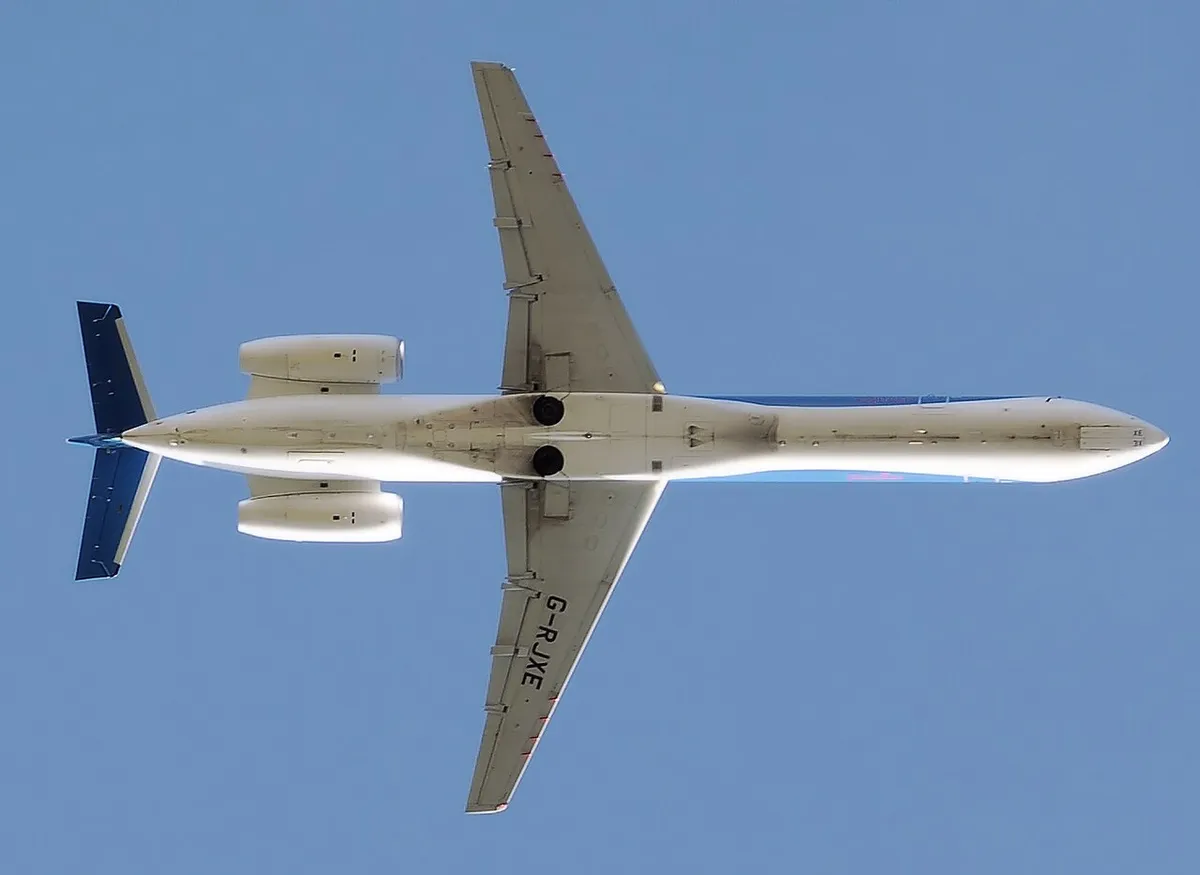
Field marks
- Engines on the back of the body plus a T-shaped tail mark it (and the CRJ) apart from any E-Jet, which has underwing engines and a low tail — the classic regional-jet split
- Absolute length (29.9 m) is unremarkable, but the body is unusually narrow for its length, giving it a pencil-thin, stretched look despite carrying only 50 seats
- Long, needle-like pointed nose, inherited from the EMB-120 Brasilia turboprop this family was derived from
- A visible exhaust pipe from the plane's small onboard generator (the APU) pokes out below the tail fin — look for it to separate a distant ERJ145 from a similarly shaped CRJ200
Specs
- Length
- 29.87 m
- Wingspan
- 20.04 m
- Engines
- Rolls-Royce AE3007A1/A1P
- Typical seats
- 50
Size and shape, to scale
Photos can't hold a consistent scale from shot to shot — these silhouettes are all drawn at the same 10 px = 1 m scale, so the proportions here are trustworthy even though the photos above aren't.
Variant notes
- Descended from the shorter ERJ135/140 (not in this dataset) — all three share the same slim 2.28 m body cross-section and nose
- Cabin seats one-and-two across the single aisle (three abreast total), not the usual two-and-two or three-and-three of larger jets
- United and several regional carriers are winding down their ERJ145 fleets, but SkyWest, Envoy, and international operators keep it common through the late 2020s